

Rost Universal Concentrate 1 L
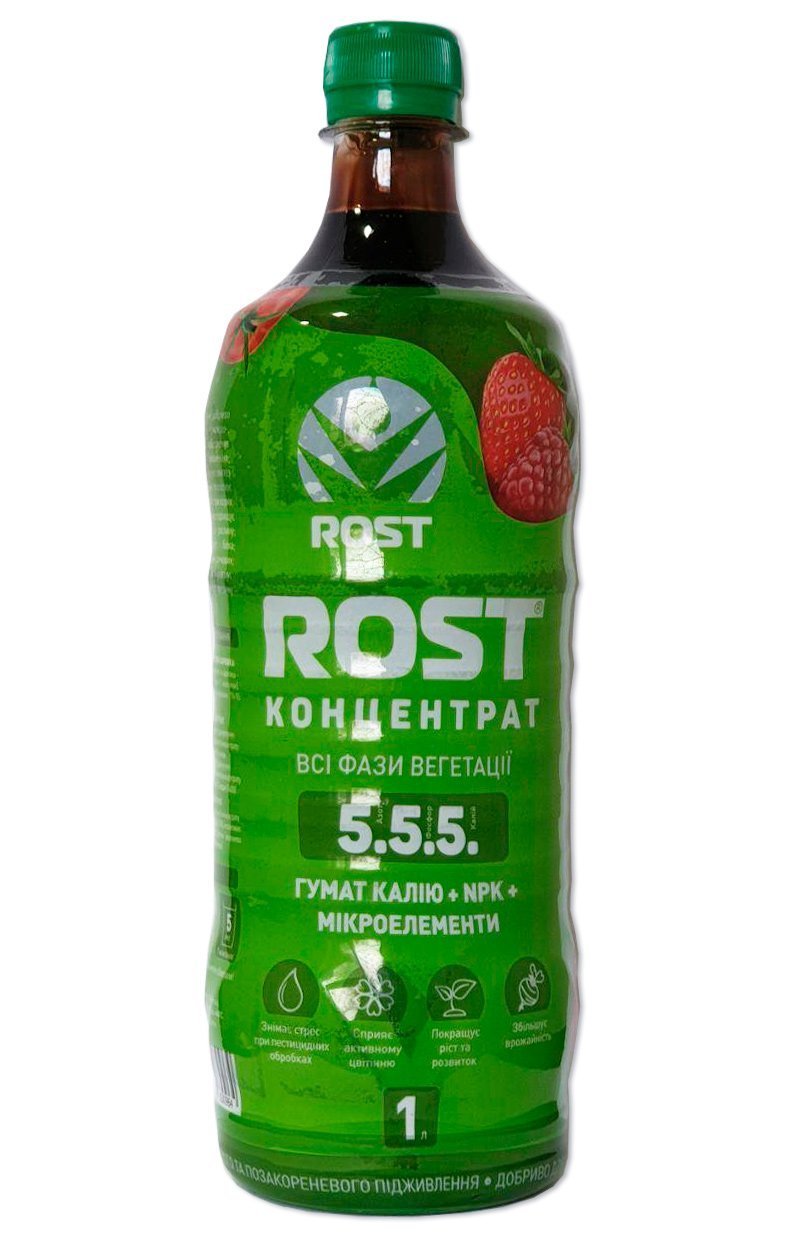
Rost Universal Concentrate 1 L
Rost Universal Concentrate (1000 ml) - a complex organic-mineral liquid fertilizer for root and foliar feeding.
Fertilizer composition: The base is potassium humate; the fertilizer is enriched with macronutrients—nitrogen, phosphorus, and potassium in varying percentages—as well as a full set of micronutrients in chelated form.
Advantages:
- Provides all necessary nutrients, which are fully absorbed by the plant.
- Promotes uniform germination and sprouting of seeds and tubers.
- Development of a strong root system.
- Fruit ripening occurs 6–14 days earlier.
- Improves fruit quality by increasing vitamin content.
- Increases plant resistance to various diseases and adverse environmental factors—extreme temperatures (frost, drought).
Application:
|
Crop | Effectiveness of vegetative development of agricultural crops, yield | Effectiveness against diseases on agricultural crops |
| Winter and spring wheat,
Winter rye, Winter and spring barley, Winter triticale | Increase: in yield by an average of 10–15%
in tillering by 0.8–1% in seed weight by 11–13% root system mass by 40–60% increase in grain gluten content by 5% improvement in gluten quality increase in grain protein content by 1.5–2% reduced lodging | 2-3 times less powdery mildew,
70% less root rot, septoria and fusarium by 60–70% |
| Sunflower | increased yield by an average of 10–20% | Reduced susceptibility: to downy mildew by 1.5 times,
gray, white, and ash rot by 2.8 times, dry rot of flower heads by 1.6 times, verticillium wilt by 2.2 times, rust by 2 times, phamosis by 1.8 times |
| Potatoes | increase: in yield by an average of 15–22%,
in the number of marketable tubers by 8–10%, dry matter content by 5–10%, starch content by 8–10%, increase in vitamin C content by an average of 5 mg/%, reduction in nitrate content by 20–30% | reduction in susceptibility:
late blight by 3–6.6 times, macrosporiosis by 3.3–12.5 times, wilting by 2.7–3.6 times, scab by 40–50%, wet rot by 60–70% |
| Cabbage | germination rate by 17–18%,
increase: yield by an average of 18–25%, head size and density vitamin C content by 4–5 mg/%, yield of marketable heads by 6% | significant reduction in susceptibility to various diseases |
| Tomatoes | increase in yield by an average of 20-25%,
increase in: dry matter content by 2.8%, sugar content by 2.6%, vitamin C content by 2–3 mg/%, decrease in acidity by 3.4% | decrease in susceptibility to:
by late blight by 1.4–2.9 times, by Alternaria by 1.6–2.9 times, by Septoria by 1.4–2 times, by black bacterial spot by 1.5–2 times |
| Cucumbers | increase in seed germination by 17–20%,
increase in yield by an average of 15–40% | reduction in susceptibility:
to downy mildew by 2 times bacterial blight by 2 times powdery mildew by 1.9 times, and wilt by 1.5 times |
| Apple, Pear,
Cherry, Plum, Quince, Peach, Apricot | average yield increase of 20% | 40–60% reduction in scab damage |
| Grapes | average yield increase of 25–30% | reduction in susceptibility: downy mildew by 1.6–2.3 times,
powdery mildew by 2 times, gray and white rot by 2.3 times, anthracnose by 3 times |
| Watermelons | average yield increase of 50% |
Application rates:
- Open field. Foliar feeding - cereals, industrial crops, vegetables, melons, berries, flowers, and others - Dissolve 20 g of concentrate in 10 L of water (1:600) and treat 200 m² of plants.
- Fruit trees, shrubs, and grapes – 25 g per 10 L of water
- Root feeding. The application rate of the product increases by 15–20%, i.e., 25 mL per 10 L of water (1:500).
- Greenhouse cultivation. For use in greenhouse operations, the recommended concentration of the product is 36 g per 10 L of water, regardless of the type of application (root or foliar).
- Seed soaking and seedling rooting. Preparation of the working solution: 35 ml per 10 L of water (1:300).
-
Seeds
 Seeds
Buy seeds with a harvest guarantee at the "Sad-Ogorod" online store
Want to buy seeds with high germination rates at an affordable price? The "Sad-Ogorod" online store offers a wide selection of vegetable, herb, and melon seeds. Here you’ll find seeds for tomatoes, cucumbers, peppers, cabbage, carrots, beets, dill, parsley, lettuce, zucchini, eggplant, watermelon, melon, and other popular crops.
✅ Why is it beneficial to buy seeds from us?
✔ High-quality seeds from leading producers — consistent germination and high yields.
✔ A wide selection of proven varieties and hybrids for greenhouses and open fields.
✔ The ability to purchase seeds retail at wholesale prices.
✔ Fast delivery throughout Ukraine: Kharkiv, Kyiv, Dnipro, Odesa, Lviv, and other cities.
✔ Affordable prices, positive customer reviews, and professional advice.
We offer only proven seeds that have stood the test of time and are suitable for farmers, gardeners, and summer residents alike. Order seeds from the “Sad-Gorod” online store today and enjoy a bountiful, high-quality harvest!
📌 Go to the catalog and select seeds:
Seeds
Buy seeds with a harvest guarantee at the "Sad-Ogorod" online store
Want to buy seeds with high germination rates at an affordable price? The "Sad-Ogorod" online store offers a wide selection of vegetable, herb, and melon seeds. Here you’ll find seeds for tomatoes, cucumbers, peppers, cabbage, carrots, beets, dill, parsley, lettuce, zucchini, eggplant, watermelon, melon, and other popular crops.
✅ Why is it beneficial to buy seeds from us?
✔ High-quality seeds from leading producers — consistent germination and high yields.
✔ A wide selection of proven varieties and hybrids for greenhouses and open fields.
✔ The ability to purchase seeds retail at wholesale prices.
✔ Fast delivery throughout Ukraine: Kharkiv, Kyiv, Dnipro, Odesa, Lviv, and other cities.
✔ Affordable prices, positive customer reviews, and professional advice.
We offer only proven seeds that have stood the test of time and are suitable for farmers, gardeners, and summer residents alike. Order seeds from the “Sad-Gorod” online store today and enjoy a bountiful, high-quality harvest!
📌 Go to the catalog and select seeds:
- Mushroom mycelium
- Agricultural nonwoven fabric (spunbond)
-
Nets
Nets
In this section, you can select and purchase various types of nets for a wide range of applications. Vegetable nets and polypropylene bags—for packaging, storing, and transporting various agricultural products—are practical and easy to use, moisture-proof, frost-resistant, cost-effective, and environmentally friendly for use with food products. Grape cluster protection nets—allow you to keep ripening grapes on the vine for a longer period, reliably protect grapes from insect pests, wasps, and birds, while preventing the berries from rotting or being damaged by hail. Cucumber netting (trellis netting) is used to support climbing plants, guide their growth, and grow vegetables vertically in open fields, achieving cost savings through more efficient use of planting areas—yields can be doubled per square meter. Shade nets—help protect vegetable and fruit crops on land plots from the scorching sun, retain moisture in the soil, allowing plants to be watered less frequently than usual, and serve as protection for plantings by shielding them from hail, rain, wind, pests, and other external factors.
-
Everything for irrigation
 Everything for irrigation
Tools and materials used for watering plants. This section of the catalog of products for your garden and vegetable garden features high-quality universal trigger sprayers—nozzles for "Rosinka"-type PET bottles, as well as pump-type sprayers. Indispensable tools for spraying any liquids (water, fertilizer solutions, pesticides, and other aggressive substances in liquid form). Convenient and simple, they are widely used both in the home and in gardening. Watering hoses—these devices are, in most cases, simply indispensable for keeping your garden or vegetable patch in good condition. You can achieve good results with watering hoses at a very low cost: a meter of the highest-quality hose is available at a very affordable price in our agricultural store. Drip irrigation is the most effective and preferred method of watering, providing a slow and even release of water with automatic regulation. This is an advanced method of watering crops, in which water is supplied in small doses through densely branched pipes and reaches the plant roots directly via special drippers. Such watering throughout the entire growing season allows you to maintain soil moisture close to the optimal level.
Everything for irrigation
Tools and materials used for watering plants. This section of the catalog of products for your garden and vegetable garden features high-quality universal trigger sprayers—nozzles for "Rosinka"-type PET bottles, as well as pump-type sprayers. Indispensable tools for spraying any liquids (water, fertilizer solutions, pesticides, and other aggressive substances in liquid form). Convenient and simple, they are widely used both in the home and in gardening. Watering hoses—these devices are, in most cases, simply indispensable for keeping your garden or vegetable patch in good condition. You can achieve good results with watering hoses at a very low cost: a meter of the highest-quality hose is available at a very affordable price in our agricultural store. Drip irrigation is the most effective and preferred method of watering, providing a slow and even release of water with automatic regulation. This is an advanced method of watering crops, in which water is supplied in small doses through densely branched pipes and reaches the plant roots directly via special drippers. Such watering throughout the entire growing season allows you to maintain soil moisture close to the optimal level.
-
Everything for seedlings
Everything for seedlings
This section features effective tools for plant seedlings: greenhouses and seedling trays, pots, peat and coconut pellets. Seedling trays and greenhouses are a cost-effective and convenient way to grow your future harvest; they include a tray to retain moisture and a seedling tray. Seedling pots, available in various diameters and sizes, are used in gardening and floriculture and are designed for growing any plants, vegetable seedlings, and various ornamental plants. They are intended for both professionals and hobbyists. Peat pellets are an effective and simplified way to grow seedlings of vegetable and flower crops. By using this product for seedlings, you will find it convenient to use and achieve better results when growing any crops than with the conventional seedling method.
- Insecticides
- Herbicides
- Fungicides
- Plant growth stimulants
- Plant Bioprotection
- Seed treatments
- Polyethylene film
- Adhesives
- Universal plant protection products
-
Fertilizers
- "Master" Fertilizers
- "Clean Leaf" Crystal Fertilizer 900 g
- "Plantator" Fertilizers
- "Baikal" Fertilizers
- "Helatin" Fertilizers
- "Magic Mix" Fertilizers
- "Kemira Lux" Fertilizers
- Mineral fertilizers
- Humate-based fertilizers
- "Quantum" Fertilizers
- "Stimul" Fertilizers
- "Clean Leaf" Plant Care Products
- "Clean Leaf" Crystal Fertilizers 20 g
- "Avangard" Fertilizers
- "Sudarushka" and "Ryazanochka" fertilizers
- "Chisty List" crystalline fertilizers, 100 g
- "Clean Leaf" Crystal Fertilizer 300 g
- "Clean Leaf" Fertilizer in Sticks
Fertilizers
Fertilizers for your garden and vegetable garden. This product category offers our customers the best and most in-demand high-quality fertilizers for growing a wide variety of agricultural crops and plants. These are concentrated water-soluble fertilizers—granulated and universal—containing mineral, nitrogen, phosphorus, urea, sodium, calcium, and ammonium (nitrate) additives and compounds. We offer a range of fertilizers from Agrolux, Reacom, Master, and Plantafol, as well as nitrogen fertilizers such as urea and ammonium nitrate. Baikal EM1 is a concentrated, universal liquid formulation containing a large number of beneficial microorganisms that naturally inhabit the soil. The following products are in high demand and available for purchase: boric acid, potassium humate and potassium fertilizer, Ryazanochka, Sudarushka, magnesium sulfate, zinc sulfate, potassium nitrate, and the phosphorus fertilizer Superphosphate, as well as many others.
- "Master" Fertilizers
- Sprayers
- Flower pots, planters
- Gloves
- Tents
- Measures to protect against the Colorado potato beetle
- Pest control products for cockroaches, German cockroaches, bed bugs, fleas, and house and garden ants
- Protection against mosquitoes, gnats, ticks, wasps, midges, and horseflies
- Fly repellents
- Moth repellents
- Measures to protect against cabbage root maggots
- Mole control products
- Rodent Control Products
- Products for septic tanks, cesspools, and outhouses, biodegradable agents
- Household goods
- Plant protection products
- Best Sellers
- Buy seeds - bestsellers
-
Archive
- Assortment 1
- Assortment 2
- Assorted 3
- Substrates
- "Agrolyuks" Fertilizers
- Candles
- Pickling bags
- Fertilizer Application
- Seeds Professional Packaging Netherlands
- Cucumber seeds in professional packaging

- Tomato seeds in professional packaging
- Watermelon seeds in professional packaging
- Eggplant seeds in professional packaging
- Zucchini seeds in professional packaging
- Cabbage seeds in professional packaging
- Pepper seeds in professional packaging
- Carrot seeds in professional packaging
- Beet seeds in professional packaging
- Radish seeds in professional packaging
- Cucumber seeds in professional packaging
Archive
Archive of products that are currently out of stock, but if they become available, we will easily move them to the appropriate sections. If you have landed on this page and see that a product is out of stock, you may be interested in other similar or related products—please use the search function on our website or browse other sections.
- Assortment 1


