

Super Fas household powder 10 g
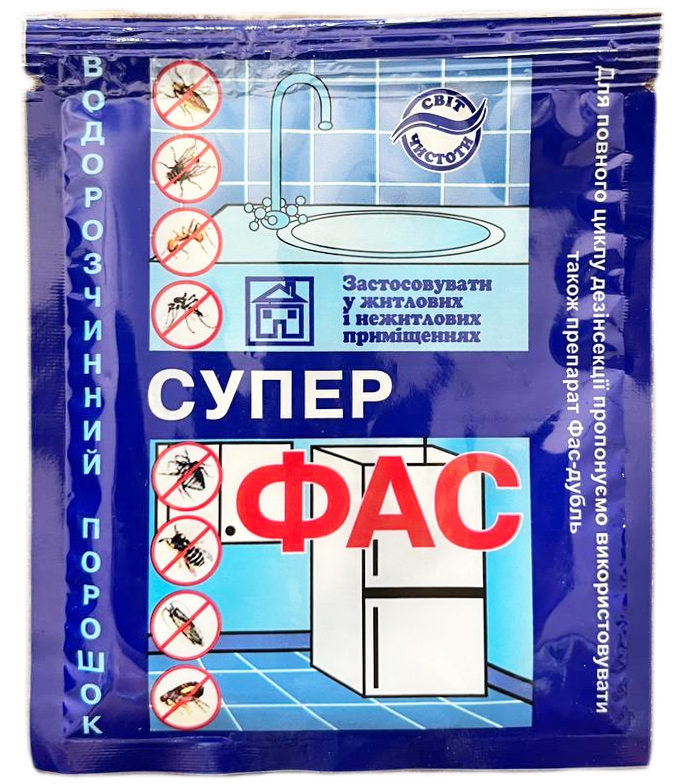
Super Fas household powder 10 g
The insecticide Super FAS is a light gray water-soluble powder. The product has a potent insecticidal and acaricidal effect (with residual activity lasting up to 6 weeks) for the control of the following insects:
- cockroaches
- ants
- bedbugs
- fleas
- wasps
- flies
- mosquitoes
- rat mites
- moths
INDICATIONS
The product is intended for the elimination of cockroaches, ants, bedbugs, fleas, moths, wasps, flies, mosquitoes, and rat mites in various types of facilities by personnel of organizations authorized to perform disinfection activities, as well as by the general public in domestic settings. In food, childcare, and healthcare facilities, treatments are performed only on designated sanitation days.
COMPOSITION
Thiamethoxam – 4% (a compound from the neonicotinoid group) and the pyrethroid zeta-cypermethrin 1%, water-soluble fillers.
METHOD OF APPLICATION AND DOSAGE
Cockroaches: For extermination, use 0.05% (by active ingredient) working aqueous solutions at a rate of 50 ml/m², selectively treating surfaces where insects are found, localized, and along their movement paths. Pay special attention to holes and cracks in walls, door frames, thresholds, along baseboards, in wall coverings, as well as ventilation vents and joints in water supply, heating, and sewer pipes.
When treating non-absorbent surfaces—such as tile, glass, and other modern finishes—the concentration of the working aqueous solution may be reduced to 0.025% by weight, and the application rate increased to 100 ml/m².
Treatment is carried out simultaneously in all rooms infested with cockroaches. In cases of high or very high infestation, adjacent rooms are treated as a preventive measure to stop migration and subsequent infestation by cockroaches. Repeat treatments are performed if insects reappear.
Ants: To eliminate red house ants and other ant species that frequently enter premises, treat their trails (pathways) or gathering sites. Use working aqueous solutions with a concentration of 0.05% (by weight). Repeat treatments are performed when ants reappear.
bedbugs: to eliminate them, use 0.05% (by DV) working aqueous solutions. If the room has a minor infestation of bedbugs, treat only their habitats; in cases of heavy infestation and where walls are plastered, dry plastering treatment should also be applied in areas where they may settle: cracks along baseboards and moldings, areas where wallpaper is peeling, around door and window frames and ventilation grilles, cracks in walls and furniture, as well as the undersides of carpets. Do not treat bedding. Simultaneous treatment of all rooms is carried out only in dormitories, where frequent insect infestation is possible. Repeat treatments are performed upon detection of insects.
fleas: for extermination, use 0.0125% (by volume) working aqueous solutions, treating walls (up to a height of 1 m), the floor surface where linoleum and baseboards are loose, the gaps behind baseboards, carpets, and the undersides of rugs. When treating cluttered basements, these areas are first cleared of debris and then thoroughly sprayed. Repeat treatments are carried out based on entomological indications.
flies: to eliminate adult houseflies or other fly species, a 0.05% (by weight) working aqueous solution is used to spray areas where flies land indoors, as well as exterior walls of buildings, trash bins, trash chambers, and sand trap units. The application rate of the solution is 50–100 ml/m² depending on the number of flies and the type of surface being treated.
To destroy fly larvae, use 0.0125–0.025% (by active ingredient) working aqueous solutions to treat their breeding sites (cesspools, waste, food waste) at intervals of once every 30–40 days. The application rate is 1 L of a 0.0125% working aqueous solution per 1 m² for waste layers up to 50 cm thick. When treating cesspools 3–5 m deep, the concentration is increased to 0.025%. Repeat treatments are performed when winged flies appear indoors.
Moths: To eliminate them, use a 0.05% (by weight) working aqueous solution, which should be sprayed on areas where they may land: carpets, rugs, upholstered furniture, and outerwear—until lightly moistened. The solution application rate is 100 ml per 8–10 m² of surface area.
Repeat treatments should be performed when moths appear.
wasps: to eliminate wasps, spray the nest from the outside with a 0.05% working aqueous solution. Treatment should be carried out in the early morning hours when it is still cool and wasp activity is minimal. The application rate depends on the size of the nest, but at least 100–200 ml should be applied to each one. Nests are treated during the summer and before the start of fall, since wasp colonies are annual and do not return to old nests.
mosquitoes: to eliminate adult mosquitoes, use 0.0125% (by active ingredient) working aqueous solutions, which are sprayed on mosquito landing sites indoors, as well as on the exterior walls of buildings or inside fences around trash containers, where mosquitoes seek shelter during hot weather.
To destroy mosquito larvae, 0.0125–0.00625% (by DV) working aqueous solutions are used (depending on the number of larvae and water contamination), which are evenly sprayed over the surface of enclosed urban water bodies: basements of residential buildings, wastewater, fire protection tanks, or open water bodies of non-fishery significance where mosquito larvae breed. The application rate is 100 ml per 1 m² of water surface. Repeat treatments are carried out based on entomological indications: when live mosquito larvae are observed. Treatments are repeated no more than once a month.
rat mites: for extermination, use 0.05% (by active ingredient) working aqueous solutions, which are sprayed on: manholes, pipes of various utilities, baseboards, walls, and floors along them, as well as areas where mites may congregate—heated sections of walls and floors near heating appliances and heating systems, the undersides of furniture, and work desks, which are treated in their entirety, including any drawers. If there are false ceilings or walls behind which rodents can move, these areas must also be treated. The application rate is at least 100 ml of working aqueous solution per 1 m² of treated surface. Repeat treatment is performed as indicated, but no earlier than 25–30 days after the first treatment.
Amount of Super FAS required to prepare working solutions
| Type of arthropod | Concentration (%) according to the product label | Concentration (%) of working solution by formulation | Amount of product (g) per (L) of water | ||
| 1 | 10 | 100 | |||
| Cockroaches | 0.05 | 1.00 | 10.0 | 100 | 1000 |
| Bedbugs | 0.05 | 1.00 | 10.0 | 100 | 1000 |
| Ants | 0.05 | 1.00 | 10.0 | 100 | 1000 |
| Wasps | 0.05 | 1.00 | 10.0 | 100 | 1000 |
| Fleas | 0.0250 | 0.50 | 5 | 50 | 500 |
| Adult flies | 0.0500 | 1.00 | 10.0 | 100 | 1000 |
| Moths | 0.0500 | 1.00 | 10.0 | 100 | 1000 |
| Fly larvae | 0.0500 | 0.25 | 2.5 | 25 | 250 |
| Adult mosquitoes | 0.0250 | 0.25 | 2.5 | 25.0 | 250 |
| Mosquito larvae | 0.0125 | 0.25 | 2.5 | 25.0 | 250 |
| Rat mites | 0.0500 | 1.00 | 100 | 100.0 | 1000 |
To destroy adult and larval arthropods, use freshly prepared solutions in concentrations of 0.05–0.00625% by weight. To prepare working solutions, dissolve the product in water at room temperature, stirring evenly. The calculation of the amount of product required to prepare working solutions is shown in the table.
When working with aqueous working solutions, use spraying equipment of various brands. The application rate for the aqueous working solution is 50 ml/m² (non-moisture-absorbing surface) and 100 ml/m² (for moisture-absorbing surfaces). Remove the product from treated surfaces using a wet method—with a cloth and a soap-soda solution—24 hours after application, but no later than 3 hours before the start of the workday. From other areas—after 4–6 weeks—once it has lost its effectiveness.
PRECAUTIONS
- Treatment of premises should be carried out in the absence of people, pets, and birds, with windows open. Food, dishes, and aquariums should be removed or thoroughly covered before treatment. When treating industrial facilities, products that may absorb the product should be removed and thoroughly covered beforehand. The room should be well ventilated for at least 30 minutes after treatment, with no people present. Treatment in childcare and food service facilities should be carried out on sanitary days or days off. After pest control, the room should be wet-cleaned using a soap-and-soda solution. It is safe to re-enter the room 1–2 hours after treatment is complete.
- Premises treated with the product must not be used until they have been cleaned, which must be done no later than 3 hours before the premises are used for their intended purpose. Cleaning should be performed while wearing gloves, using a solution of soda ash (30–50 g per 1 L of water).
- Those working with the product must observe the following precautions: before starting work with the product, the pest control technician conducts a briefing on safety procedures and first aid measures. Persons performing pest control, packaging the product, or preparing solutions must use personal protective equipment.
- Personal protective equipment includes: a cotton lab coat or coveralls, a headscarf, a waxed or rubberized apron and arm covers, rubber technical gloves or cotton gloves with a film coating, sealed safety goggles, and universal respirators with a "Type A" gas filter cartridge (approximate protection time—at least 100 hours).
- After finishing work, work clothes should be shaken out outdoors and washed. Wash them as needed, but at least once a week, after soaking them in a hot soap-and-soda solution for 2–3 hours (50 g of baking soda and 27 g of soap per 1 bucket of water), then wash in a fresh soap-and-soda solution.
- When working with the product, personal hygiene rules must be strictly observed. Smoking, eating, and drinking are prohibited in the treated area. After finishing work with the product, rinse your mouth and wash your hands and face with soap.
- Take a 10- to 15-minute break every 45 minutes of work with the product; during this break, you must go outside for fresh air, removing your protective clothing, respirator, or gas mask.
- It is prohibited to use products for treating premises that do not have a product label indicating the name, date of manufacture, and percentage of the active ingredient.
FIRST AID MEASURES
- Violations of safety rules or accidents may result in acute poisoning, the symptoms of which include: a bad taste in the mouth, weakness, vomiting, headache, nausea, abdominal pain, respiratory irritation, and excessive salivation.
- In case of poisoning through the respiratory tract, the victim should be immediately removed from the room to fresh air; contaminated clothing should be carefully removed, and the mouth should be rinsed with water or a 2% baking soda solution. Then give the victim 1–2 glasses of water with activated charcoal (10–15 tablets).
- If the product accidentally comes into contact with the skin, gently remove the dust (without rubbing) with a cotton swab, then wash the skin with warm water and soap, and apply a cream such as “Silicone.”
- If the product accidentally comes into contact with the mucous membranes of the eyes, immediately rinse them thoroughly under running water. If irritation of the mucous membrane occurs, instill 30% sodium sulfacyl into the eyes; if pain occurs, use a 2% solution of novocaine.
- If the skin is contaminated, remove the solution droplets with a cotton swab without rubbing, then wash the contaminated area with soap and water.
- If the product is accidentally swallowed, drink several glasses of water and induce vomiting, then flush the stomach with a 2% solution of baking soda or drink 1–2 glasses of water with activated charcoal (10–15 tablets). Do not put anything in the mouth of a person who has lost consciousness.
- After first aid has been administered, the victim should seek medical attention.
PACKAGING
The product is packaged in a composite polymer film bag, weight 10 g (100 units per shipping package).
TRANSPORTATION
Suitable for all modes of transport in accordance with cargo transportation regulations.
STORAGE
Store the product in a dry and cool storage area in a sealed container at a temperature not lower than -20°C and not higher than +40°C. Packages containing unused product should be stored in a well-ventilated area. The shelf life, when stored under these conditions, is 2 years from the date of manufacture.
-
Seeds
 Seeds
Buy seeds with a harvest guarantee at the "Sad-Ogorod" online store
Want to buy seeds with high germination rates at an affordable price? The "Sad-Ogorod" online store offers a wide selection of vegetable, herb, and melon seeds. Here you’ll find seeds for tomatoes, cucumbers, peppers, cabbage, carrots, beets, dill, parsley, lettuce, zucchini, eggplant, watermelon, melon, and other popular crops.
✅ Why is it beneficial to buy seeds from us?
✔ High-quality seeds from leading producers — consistent germination and high yields.
✔ A wide selection of proven varieties and hybrids for greenhouses and open fields.
✔ The ability to purchase seeds retail at wholesale prices.
✔ Fast delivery throughout Ukraine: Kharkiv, Kyiv, Dnipro, Odesa, Lviv, and other cities.
✔ Affordable prices, positive customer reviews, and professional advice.
We offer only proven seeds that have stood the test of time and are suitable for farmers, gardeners, and summer residents alike. Order seeds from the “Sad-Gorod” online store today and enjoy a bountiful, high-quality harvest!
📌 Go to the catalog and select seeds:
Seeds
Buy seeds with a harvest guarantee at the "Sad-Ogorod" online store
Want to buy seeds with high germination rates at an affordable price? The "Sad-Ogorod" online store offers a wide selection of vegetable, herb, and melon seeds. Here you’ll find seeds for tomatoes, cucumbers, peppers, cabbage, carrots, beets, dill, parsley, lettuce, zucchini, eggplant, watermelon, melon, and other popular crops.
✅ Why is it beneficial to buy seeds from us?
✔ High-quality seeds from leading producers — consistent germination and high yields.
✔ A wide selection of proven varieties and hybrids for greenhouses and open fields.
✔ The ability to purchase seeds retail at wholesale prices.
✔ Fast delivery throughout Ukraine: Kharkiv, Kyiv, Dnipro, Odesa, Lviv, and other cities.
✔ Affordable prices, positive customer reviews, and professional advice.
We offer only proven seeds that have stood the test of time and are suitable for farmers, gardeners, and summer residents alike. Order seeds from the “Sad-Gorod” online store today and enjoy a bountiful, high-quality harvest!
📌 Go to the catalog and select seeds:
- Mushroom mycelium
- Agricultural nonwoven fabric (spunbond)
-
Nets
Nets
In this section, you can select and purchase various types of nets for a wide range of applications. Vegetable nets and polypropylene bags—for packaging, storing, and transporting various agricultural products—are practical and easy to use, moisture-proof, frost-resistant, cost-effective, and environmentally friendly for use with food products. Grape cluster protection nets—allow you to keep ripening grapes on the vine for a longer period, reliably protect grapes from insect pests, wasps, and birds, while preventing the berries from rotting or being damaged by hail. Cucumber netting (trellis netting) is used to support climbing plants, guide their growth, and grow vegetables vertically in open fields, achieving cost savings through more efficient use of planting areas—yields can be doubled per square meter. Shade nets—help protect vegetable and fruit crops on land plots from the scorching sun, retain moisture in the soil, allowing plants to be watered less frequently than usual, and serve as protection for plantings by shielding them from hail, rain, wind, pests, and other external factors.
-
Everything for irrigation
 Everything for irrigation
Tools and materials used for watering plants. This section of the catalog of products for your garden and vegetable garden features high-quality universal trigger sprayers—nozzles for "Rosinka"-type PET bottles, as well as pump-type sprayers. Indispensable tools for spraying any liquids (water, fertilizer solutions, pesticides, and other aggressive substances in liquid form). Convenient and simple, they are widely used both in the home and in gardening. Watering hoses—these devices are, in most cases, simply indispensable for keeping your garden or vegetable patch in good condition. You can achieve good results with watering hoses at a very low cost: a meter of the highest-quality hose is available at a very affordable price in our agricultural store. Drip irrigation is the most effective and preferred method of watering, providing a slow and even release of water with automatic regulation. This is an advanced method of watering crops, in which water is supplied in small doses through densely branched pipes and reaches the plant roots directly via special drippers. Such watering throughout the entire growing season allows you to maintain soil moisture close to the optimal level.
Everything for irrigation
Tools and materials used for watering plants. This section of the catalog of products for your garden and vegetable garden features high-quality universal trigger sprayers—nozzles for "Rosinka"-type PET bottles, as well as pump-type sprayers. Indispensable tools for spraying any liquids (water, fertilizer solutions, pesticides, and other aggressive substances in liquid form). Convenient and simple, they are widely used both in the home and in gardening. Watering hoses—these devices are, in most cases, simply indispensable for keeping your garden or vegetable patch in good condition. You can achieve good results with watering hoses at a very low cost: a meter of the highest-quality hose is available at a very affordable price in our agricultural store. Drip irrigation is the most effective and preferred method of watering, providing a slow and even release of water with automatic regulation. This is an advanced method of watering crops, in which water is supplied in small doses through densely branched pipes and reaches the plant roots directly via special drippers. Such watering throughout the entire growing season allows you to maintain soil moisture close to the optimal level.
-
Everything for seedlings
Everything for seedlings
This section features effective tools for plant seedlings: greenhouses and seedling trays, pots, peat and coconut pellets. Seedling trays and greenhouses are a cost-effective and convenient way to grow your future harvest; they include a tray to retain moisture and a seedling tray. Seedling pots, available in various diameters and sizes, are used in gardening and floriculture and are designed for growing any plants, vegetable seedlings, and various ornamental plants. They are intended for both professionals and hobbyists. Peat pellets are an effective and simplified way to grow seedlings of vegetable and flower crops. By using this product for seedlings, you will find it convenient to use and achieve better results when growing any crops than with the conventional seedling method.
- Insecticides
- Herbicides
- Fungicides
- Plant growth stimulants
- Plant Bioprotection
- Seed treatments
- Polyethylene film
- Adhesives
- Universal plant protection products
-
Fertilizers
- "Master" Fertilizers
- "Clean Leaf" Crystal Fertilizer 900 g
- "Plantator" Fertilizers
- "Baikal" Fertilizers
- "Helatin" Fertilizers
- "Magic Mix" Fertilizers
- "Kemira Lux" Fertilizers
- Mineral fertilizers
- Humate-based fertilizers
- "Quantum" Fertilizers
- "Stimul" Fertilizers
- "Clean Leaf" Plant Care Products
- "Clean Leaf" Crystal Fertilizers 20 g
- "Avangard" Fertilizers
- "Sudarushka" and "Ryazanochka" fertilizers
- "Chisty List" crystalline fertilizers, 100 g
- "Clean Leaf" Crystal Fertilizer 300 g
- "Clean Leaf" Fertilizer in Sticks
Fertilizers
Fertilizers for your garden and vegetable garden. This product category offers our customers the best and most in-demand high-quality fertilizers for growing a wide variety of agricultural crops and plants. These are concentrated water-soluble fertilizers—granulated and universal—containing mineral, nitrogen, phosphorus, urea, sodium, calcium, and ammonium (nitrate) additives and compounds. We offer a range of fertilizers from Agrolux, Reacom, Master, and Plantafol, as well as nitrogen fertilizers such as urea and ammonium nitrate. Baikal EM1 is a concentrated, universal liquid formulation containing a large number of beneficial microorganisms that naturally inhabit the soil. The following products are in high demand and available for purchase: boric acid, potassium humate and potassium fertilizer, Ryazanochka, Sudarushka, magnesium sulfate, zinc sulfate, potassium nitrate, and the phosphorus fertilizer Superphosphate, as well as many others.
- "Master" Fertilizers
- Sprayers
- Flower pots, planters
- Gloves
- Tents
- Measures to protect against the Colorado potato beetle
- Pest control products for cockroaches, German cockroaches, bed bugs, fleas, and house and garden ants
- Protection against mosquitoes, gnats, ticks, wasps, midges, and horseflies
- Fly repellents
- Moth repellents
- Measures to protect against cabbage root maggots
- Mole control products
- Rodent Control Products
- Products for septic tanks, cesspools, and outhouses, biodegradable agents
- Household goods
- Plant protection products
- Best Sellers
- Buy seeds - bestsellers
-
Archive
- Assortment 1
- Assortment 2
- Assorted 3
- Substrates
- "Agrolyuks" Fertilizers
- Candles
- Pickling bags
- Fertilizer Application
- Seeds Professional Packaging Netherlands
- Cucumber seeds in professional packaging

- Tomato seeds in professional packaging
- Watermelon seeds in professional packaging
- Eggplant seeds in professional packaging
- Zucchini seeds in professional packaging
- Cabbage seeds in professional packaging
- Pepper seeds in professional packaging
- Carrot seeds in professional packaging
- Beet seeds in professional packaging
- Radish seeds in professional packaging
- Cucumber seeds in professional packaging
Archive
Archive of products that are currently out of stock, but if they become available, we will easily move them to the appropriate sections. If you have landed on this page and see that a product is out of stock, you may be interested in other similar or related products—please use the search function on our website or browse other sections.
- Assortment 1


