

Working hours: Mon–Sat, 9:00 to 18:00. Orders accepted online: 24/7
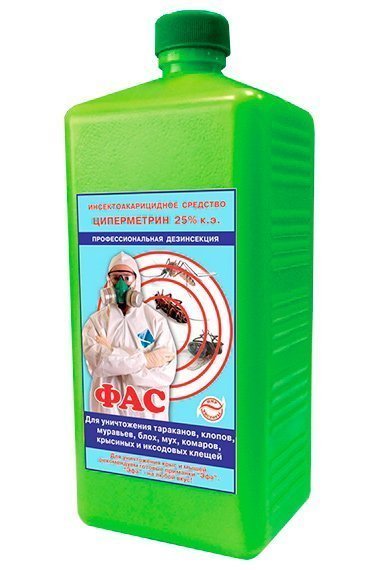
Fas Cypermethrin 25% EC 500 ml
UAH 750.00
Fas Cypermethrin 25% EC 500 ml
Quantity
Full description
Fas Cypermethrin 25% EC 500 ml. Emulsion concentrate for insect control. The insecticide and acaricide Cypermethrin 25% EC is an emulsion concentrate in the form of a homogeneous liquid ranging in color from pale yellow to yellow with a fragrance. It is classified as a Class 4 low-hazard substance.
The product has a potent insecticidal and acaricidal effect. Its residual effect in natural habitats lasts for at least 30 days. This broad-spectrum emulsion concentrate is suitable for controlling the following insects:
- mites
- cockroaches
- ants
- fleas
- flies
- bedbugs
COMPOSITION
Active ingredient (AI) cypermethrin - 25%, emulsifiers, stabilizer, solvent, fragrance.
INDICATIONS
The product is intended for professionals at organizations authorized to perform disinfection activities to eliminate ixodid ticks of the genera Ixodes, Dermacentor, and Haemophisalis when treating natural habitats, and to protect people from attacks by ixodid ticks and fleas (vectors of dangerous human diseases) when treating outerwear.
METHOD OF APPLICATION AND DOSAGE
A freshly prepared working emulsion is used to control ixodid ticks.
To prepare the working emulsion, dilute the product in tap water at room temperature or any other filtered water, stirring constantly and evenly for 5 minutes. The calculation of the amount of product required to prepare the working emulsion is presented in Table 1.
Active ingredient (AI) cypermethrin - 25%, emulsifiers, stabilizer, solvent, fragrance.
INDICATIONS
The product is intended for professionals at organizations authorized to perform disinfection activities to eliminate ixodid ticks of the genera Ixodes, Dermacentor, and Haemophisalis when treating natural habitats, and to protect people from attacks by ixodid ticks and fleas (vectors of dangerous human diseases) when treating outerwear.
METHOD OF APPLICATION AND DOSAGE
A freshly prepared working emulsion is used to control ixodid ticks.
To prepare the working emulsion, dilute the product in tap water at room temperature or any other filtered water, stirring constantly and evenly for 5 minutes. The calculation of the amount of product required to prepare the working emulsion is presented in Table 1.
| Table 1. Calculation of the amount of product required to prepare the working emulsion | ||||||
| Mite genus | Application rate, L/ha | Working emulsion concentration, % | Amount of product (ml) in working emulsion | |||
| by active ingredient | by product | 1 L | 5 L | 10 L | ||
| Ixodes | 0.25 | 0.0625 | 0.25 | 2.5 | 12.5 | 25.0 |
| 0.50 | 0.1250 | 0.50 | 5.0 | 25.0 | 50.0 | |
| 0.75 | 0.1875 | 0.75 | 7.5 | 37.5 | 75.0 | |
| Dermocentor, Haemophysalis | 1.25 | 0.3100 | 1.25 | 12.5 | 62.5 | 125.0 |
Any equipment designed for spraying insecticides onto surfaces (automatic sprayers, fine-droplet backpack sprayers, large-droplet multi-liter sprayers, small- and micro-liter sprayers, mechanically towed sprayers) with a median droplet diameter of 20–150 μm. The main requirement is to ensure uniform coverage of the entire target area with the working emulsion. If conditions permit, vehicle-mounted equipment may be used when treating areas.
Areas frequently visited by people (paths, playgrounds, etc.) must be mechanically cleared of vegetation and forest litter where ticks may be present. The remaining grassy vegetation where ticks have been detected must be treated.
If the treatment area is located within a large forest area that poses a risk of tick infestation, it is recommended to create a barrier at least 50–100 m wide.
Treatment should be carried out when the weather forecast is favorable (no precipitation) for the next 3 days.
The application rate of the working emulsion depends on the type of equipment used and the density of the vegetation cover. Typically, 100 liters of working emulsion are applied per hectare, but a larger amount is required for dense vegetation cover.
The application rate depends on the species and population density of the ticks, as well as on the density of the vegetation cover. To control ticks of the genus Ixodes: for low population densities (up to 10 ticks per flag per 1 km of route during the peak period of tick abundance and activity) and sparse vegetation cover, the application rate is 0.25 L/ha; for medium and high populations and dense vegetation cover — 0.75 L/ha; for sparse vegetation — 0.5 L/ha. To control ticks of the genera Dermocentor and Haemophysalis — 1.25 L/ha.
The product remains effective for at least 30 days. Heavy rainfall may reduce the product’s effectiveness. If necessary, based on the presence of mites in the treated area, re-treatment is possible.
To prepare a working emulsion for applying the product to clothing, use a concentration of 0.125% by volume. The calculation of the amount of product required to prepare the working emulsion is presented in Table 2.
Areas frequently visited by people (paths, playgrounds, etc.) must be mechanically cleared of vegetation and forest litter where ticks may be present. The remaining grassy vegetation where ticks have been detected must be treated.
If the treatment area is located within a large forest area that poses a risk of tick infestation, it is recommended to create a barrier at least 50–100 m wide.
Treatment should be carried out when the weather forecast is favorable (no precipitation) for the next 3 days.
The application rate of the working emulsion depends on the type of equipment used and the density of the vegetation cover. Typically, 100 liters of working emulsion are applied per hectare, but a larger amount is required for dense vegetation cover.
The application rate depends on the species and population density of the ticks, as well as on the density of the vegetation cover. To control ticks of the genus Ixodes: for low population densities (up to 10 ticks per flag per 1 km of route during the peak period of tick abundance and activity) and sparse vegetation cover, the application rate is 0.25 L/ha; for medium and high populations and dense vegetation cover — 0.75 L/ha; for sparse vegetation — 0.5 L/ha. To control ticks of the genera Dermocentor and Haemophysalis — 1.25 L/ha.
The product remains effective for at least 30 days. Heavy rainfall may reduce the product’s effectiveness. If necessary, based on the presence of mites in the treated area, re-treatment is possible.
To prepare a working emulsion for applying the product to clothing, use a concentration of 0.125% by volume. The calculation of the amount of product required to prepare the working emulsion is presented in Table 2.
| Table 2. Calculation of the amount of product required to prepare a working emulsion for treating clothing against ixodid ticks and fleas | ||||
| Concentration of working emulsion, % | Amount of product (ml) in working emulsion | |||
| by DV | by product | 1 L | 5 L | 10 L |
| 0.125 | 0.5 | 5 | 25 | 50 |
Clothing is treated by spraying. Treatment is carried out in non-residential areas equipped with exhaust ventilation or outdoors. The product is applied evenly to the spread-out clothing from a distance of 20–50 cm (depending on the type of spraying equipment), first on one side, then the clothing is turned over and the other side is treated. Special attention should be paid to treating pants, as the majority of mites and fleas attach themselves to clothing at a height of 0.2–1 m.
The concentration of the working aqueous emulsion is 0.125% active ingredient (0.50% total product). The application rate is 40 ml per square meter of fabric (jacket or shirt and pants—160–200 ml, depending on size).
After treatment, the clothing must be dried flat in the open air in the shade or in a well-ventilated room for 2 hours.
The insecticidal and acaricidal effect of treated clothing lasts up to 14 days. To extend the duration of protection, store treated clothing in a sealed plastic bag. Getting the clothing wet significantly reduces, and washing completely eliminates, its insecticidal and acaricidal effect. If the protective effect weakens or is lost, additional treatment should be performed.
PRECAUTIONS
Those working with the product must strictly observe safety precautions and personal hygiene rules.
Persons under 18 years of age, pregnant and breastfeeding women, as well as persons for whom contact with pesticides is contraindicated, are not permitted to work with the product.
Eating, drinking, and smoking are prohibited in work areas.
Persons working with the product must be provided with a set of personal protective equipment, which includes: coveralls made of thick (tarpaulin, etc.) or water-repellent fabric, a hooded cape made of polyvinyl chloride, oilcloth, rubberized, or polyvinyl chloride aprons, rubber boots—GOST 5375-79, technical rubber gloves—GOST 20010-93 (the use of medical gloves is prohibited), sealed safety goggles (PO-2, PO-3, monoblock), universal respirators RU-60M, RPG-67 with a Type A gas filter cartridge; respirators must fit snugly against the face without squeezing it. Smelling the agent under the respirator mask indicates that the gas filter cartridge is spent and must be replaced. Every day after work, the rubber face pieces of the respirator must be thoroughly wiped with a cotton swab moistened with alcohol or a 0.5% potassium permanganate solution or soap, then rinsed with clean water and dried.
After finishing work, wash your hands, face, and other exposed areas of the body that may have been splashed with emulsion. Take a shower at the end of the shift.
Observe water protection zones for rivers, ponds, lakes, and reservoirs, as well as the first and second sanitary protection zones for water supply sources and air intake devices.
The concentration of the working aqueous emulsion is 0.125% active ingredient (0.50% total product). The application rate is 40 ml per square meter of fabric (jacket or shirt and pants—160–200 ml, depending on size).
After treatment, the clothing must be dried flat in the open air in the shade or in a well-ventilated room for 2 hours.
The insecticidal and acaricidal effect of treated clothing lasts up to 14 days. To extend the duration of protection, store treated clothing in a sealed plastic bag. Getting the clothing wet significantly reduces, and washing completely eliminates, its insecticidal and acaricidal effect. If the protective effect weakens or is lost, additional treatment should be performed.
PRECAUTIONS
Those working with the product must strictly observe safety precautions and personal hygiene rules.
Persons under 18 years of age, pregnant and breastfeeding women, as well as persons for whom contact with pesticides is contraindicated, are not permitted to work with the product.
Eating, drinking, and smoking are prohibited in work areas.
Persons working with the product must be provided with a set of personal protective equipment, which includes: coveralls made of thick (tarpaulin, etc.) or water-repellent fabric, a hooded cape made of polyvinyl chloride, oilcloth, rubberized, or polyvinyl chloride aprons, rubber boots—GOST 5375-79, technical rubber gloves—GOST 20010-93 (the use of medical gloves is prohibited), sealed safety goggles (PO-2, PO-3, monoblock), universal respirators RU-60M, RPG-67 with a Type A gas filter cartridge; respirators must fit snugly against the face without squeezing it. Smelling the agent under the respirator mask indicates that the gas filter cartridge is spent and must be replaced. Every day after work, the rubber face pieces of the respirator must be thoroughly wiped with a cotton swab moistened with alcohol or a 0.5% potassium permanganate solution or soap, then rinsed with clean water and dried.
After finishing work, wash your hands, face, and other exposed areas of the body that may have been splashed with emulsion. Take a shower at the end of the shift.
Observe water protection zones for rivers, ponds, lakes, and reservoirs, as well as the first and second sanitary protection zones for water supply sources and air intake devices.
FIRST AID MEASURES
If the recommended precautions are not followed, accidental poisoning with the product may occur.
In case of poisoning through the respiratory tract, move the victim to fresh air and have them rinse their mouth with water or a 2% solution of baking soda.
If the product accidentally gets into the eyes, immediately rinse them under running water or with a 2% baking soda solution for several minutes. If conjunctival irritation occurs, instill 30% sodium sulfacyl into the eyes; if pain occurs, instill 2% novocaine.
If the recommended precautions are not followed, accidental poisoning with the product may occur.
In case of poisoning through the respiratory tract, move the victim to fresh air and have them rinse their mouth with water or a 2% solution of baking soda.
If the product accidentally gets into the eyes, immediately rinse them under running water or with a 2% baking soda solution for several minutes. If conjunctival irritation occurs, instill 30% sodium sulfacyl into the eyes; if pain occurs, instill 2% novocaine.
PACKAGING
The product is packaged in 500-ml plastic containers. Each shipping package contains 15 units.
TRANSPORTATION
Shipping is permitted by all modes of transport in accordance with the rules for the transport of dangerous goods applicable to that mode of transport, which ensure the safety of the product and packaging.
STORAGE AND SHELF LIFE
Store the product in a covered warehouse in tightly sealed containers at a temperature not exceeding +40°C and not lower than -20°C, away from fire, heating devices, and sunlight, and separate from food products and medicines. The shelf life, provided storage conditions are observed, is 5 years from the date of manufacture.
The product is packaged in 500-ml plastic containers. Each shipping package contains 15 units.
TRANSPORTATION
Shipping is permitted by all modes of transport in accordance with the rules for the transport of dangerous goods applicable to that mode of transport, which ensure the safety of the product and packaging.
STORAGE AND SHELF LIFE
Store the product in a covered warehouse in tightly sealed containers at a temperature not exceeding +40°C and not lower than -20°C, away from fire, heating devices, and sunlight, and separate from food products and medicines. The shelf life, provided storage conditions are observed, is 5 years from the date of manufacture.
-
Seeds
 Seeds
Buy seeds with a harvest guarantee at the "Sad-Ogorod" online store
Want to buy seeds with high germination rates at an affordable price? The "Sad-Ogorod" online store offers a wide selection of vegetable, herb, and melon seeds. Here you’ll find seeds for tomatoes, cucumbers, peppers, cabbage, carrots, beets, dill, parsley, lettuce, zucchini, eggplant, watermelon, melon, and other popular crops.
✅ Why is it beneficial to buy seeds from us?
✔ High-quality seeds from leading producers — consistent germination and high yields.
✔ A wide selection of proven varieties and hybrids for greenhouses and open fields.
✔ The ability to purchase seeds retail at wholesale prices.
✔ Fast delivery throughout Ukraine: Kharkiv, Kyiv, Dnipro, Odesa, Lviv, and other cities.
✔ Affordable prices, positive customer reviews, and professional advice.
We offer only proven seeds that have stood the test of time and are suitable for farmers, gardeners, and summer residents alike. Order seeds from the “Sad-Gorod” online store today and enjoy a bountiful, high-quality harvest!
📌 Go to the catalog and select seeds:
Seeds
Buy seeds with a harvest guarantee at the "Sad-Ogorod" online store
Want to buy seeds with high germination rates at an affordable price? The "Sad-Ogorod" online store offers a wide selection of vegetable, herb, and melon seeds. Here you’ll find seeds for tomatoes, cucumbers, peppers, cabbage, carrots, beets, dill, parsley, lettuce, zucchini, eggplant, watermelon, melon, and other popular crops.
✅ Why is it beneficial to buy seeds from us?
✔ High-quality seeds from leading producers — consistent germination and high yields.
✔ A wide selection of proven varieties and hybrids for greenhouses and open fields.
✔ The ability to purchase seeds retail at wholesale prices.
✔ Fast delivery throughout Ukraine: Kharkiv, Kyiv, Dnipro, Odesa, Lviv, and other cities.
✔ Affordable prices, positive customer reviews, and professional advice.
We offer only proven seeds that have stood the test of time and are suitable for farmers, gardeners, and summer residents alike. Order seeds from the “Sad-Gorod” online store today and enjoy a bountiful, high-quality harvest!
📌 Go to the catalog and select seeds:
- Mushroom mycelium
- Agricultural nonwoven fabric (spunbond)
-
Nets
Nets
In this section, you can select and purchase various types of nets for a wide range of applications. Vegetable nets and polypropylene bags—for packaging, storing, and transporting various agricultural products—are practical and easy to use, moisture-proof, frost-resistant, cost-effective, and environmentally friendly for use with food products. Grape cluster protection nets—allow you to keep ripening grapes on the vine for a longer period, reliably protect grapes from insect pests, wasps, and birds, while preventing the berries from rotting or being damaged by hail. Cucumber netting (trellis netting) is used to support climbing plants, guide their growth, and grow vegetables vertically in open fields, achieving cost savings through more efficient use of planting areas—yields can be doubled per square meter. Shade nets—help protect vegetable and fruit crops on land plots from the scorching sun, retain moisture in the soil, allowing plants to be watered less frequently than usual, and serve as protection for plantings by shielding them from hail, rain, wind, pests, and other external factors.
-
Everything for irrigation
 Everything for irrigation
Tools and materials used for watering plants. This section of the catalog of products for your garden and vegetable garden features high-quality universal trigger sprayers—nozzles for "Rosinka"-type PET bottles, as well as pump-type sprayers. Indispensable tools for spraying any liquids (water, fertilizer solutions, pesticides, and other aggressive substances in liquid form). Convenient and simple, they are widely used both in the home and in gardening. Watering hoses—these devices are, in most cases, simply indispensable for keeping your garden or vegetable patch in good condition. You can achieve good results with watering hoses at a very low cost: a meter of the highest-quality hose is available at a very affordable price in our agricultural store. Drip irrigation is the most effective and preferred method of watering, providing a slow and even release of water with automatic regulation. This is an advanced method of watering crops, in which water is supplied in small doses through densely branched pipes and reaches the plant roots directly via special drippers. Such watering throughout the entire growing season allows you to maintain soil moisture close to the optimal level.
Everything for irrigation
Tools and materials used for watering plants. This section of the catalog of products for your garden and vegetable garden features high-quality universal trigger sprayers—nozzles for "Rosinka"-type PET bottles, as well as pump-type sprayers. Indispensable tools for spraying any liquids (water, fertilizer solutions, pesticides, and other aggressive substances in liquid form). Convenient and simple, they are widely used both in the home and in gardening. Watering hoses—these devices are, in most cases, simply indispensable for keeping your garden or vegetable patch in good condition. You can achieve good results with watering hoses at a very low cost: a meter of the highest-quality hose is available at a very affordable price in our agricultural store. Drip irrigation is the most effective and preferred method of watering, providing a slow and even release of water with automatic regulation. This is an advanced method of watering crops, in which water is supplied in small doses through densely branched pipes and reaches the plant roots directly via special drippers. Such watering throughout the entire growing season allows you to maintain soil moisture close to the optimal level.
-
Everything for seedlings
Everything for seedlings
This section features effective tools for plant seedlings: greenhouses and seedling trays, pots, peat and coconut pellets. Seedling trays and greenhouses are a cost-effective and convenient way to grow your future harvest; they include a tray to retain moisture and a seedling tray. Seedling pots, available in various diameters and sizes, are used in gardening and floriculture and are designed for growing any plants, vegetable seedlings, and various ornamental plants. They are intended for both professionals and hobbyists. Peat pellets are an effective and simplified way to grow seedlings of vegetable and flower crops. By using this product for seedlings, you will find it convenient to use and achieve better results when growing any crops than with the conventional seedling method.
- Insecticides
- Herbicides
- Fungicides
- Plant growth stimulants
- Plant Bioprotection
- Seed treatments
- Polyethylene film
- Adhesives
- Universal plant protection products
-
Fertilizers
- "Master" Fertilizers
- "Clean Leaf" Crystal Fertilizer 900 g
- "Plantator" Fertilizers
- "Baikal" Fertilizers
- "Helatin" Fertilizers
- "Magic Mix" Fertilizers
- "Kemira Lux" Fertilizers
- Mineral fertilizers
- Humate-based fertilizers
- "Quantum" Fertilizers
- "Stimul" Fertilizers
- "Clean Leaf" Plant Care Products
- "Clean Leaf" Crystal Fertilizers 20 g
- "Avangard" Fertilizers
- "Sudarushka" and "Ryazanochka" fertilizers
- "Chisty List" crystalline fertilizers, 100 g
- "Clean Leaf" Crystal Fertilizer 300 g
- "Clean Leaf" Fertilizer in Sticks
Fertilizers
Fertilizers for your garden and vegetable garden. This product category offers our customers the best and most in-demand high-quality fertilizers for growing a wide variety of agricultural crops and plants. These are concentrated water-soluble fertilizers—granulated and universal—containing mineral, nitrogen, phosphorus, urea, sodium, calcium, and ammonium (nitrate) additives and compounds. We offer a range of fertilizers from Agrolux, Reacom, Master, and Plantafol, as well as nitrogen fertilizers such as urea and ammonium nitrate. Baikal EM1 is a concentrated, universal liquid formulation containing a large number of beneficial microorganisms that naturally inhabit the soil. The following products are in high demand and available for purchase: boric acid, potassium humate and potassium fertilizer, Ryazanochka, Sudarushka, magnesium sulfate, zinc sulfate, potassium nitrate, and the phosphorus fertilizer Superphosphate, as well as many others.
- "Master" Fertilizers
- Sprayers
- Flower pots, planters
- Gloves
- Tents
- Measures to protect against the Colorado potato beetle
- Pest control products for cockroaches, German cockroaches, bed bugs, fleas, and house and garden ants
- Protection against mosquitoes, gnats, ticks, wasps, midges, and horseflies
- Fly repellents
- Moth repellents
- Measures to protect against cabbage root maggots
- Mole control products
- Rodent Control Products
- Products for septic tanks, cesspools, and outhouses, biodegradable agents
- Household goods
- Plant protection products
- Best Sellers
- Buy seeds - bestsellers
-
Archive
- Assortment 1
- Assortment 2
- Assorted 3
- Substrates
- "Agrolyuks" Fertilizers
- Candles
- Pickling bags
- Fertilizer Application
- Seeds Professional Packaging Netherlands
- Cucumber seeds in professional packaging

- Tomato seeds in professional packaging
- Watermelon seeds in professional packaging
- Eggplant seeds in professional packaging
- Zucchini seeds in professional packaging
- Cabbage seeds in professional packaging
- Pepper seeds in professional packaging
- Carrot seeds in professional packaging
- Beet seeds in professional packaging
- Radish seeds in professional packaging
- Cucumber seeds in professional packaging
Archive
Archive of products that are currently out of stock, but if they become available, we will easily move them to the appropriate sections. If you have landed on this page and see that a product is out of stock, you may be interested in other similar or related products—please use the search function on our website or browse other sections.
- Assortment 1


