

Beloplodny Vuyko zucchini seeds, 20 g
14.04 UAH — when ordering from 20 pcs.
Beloplodny Vuyko zucchini seeds, 20 g
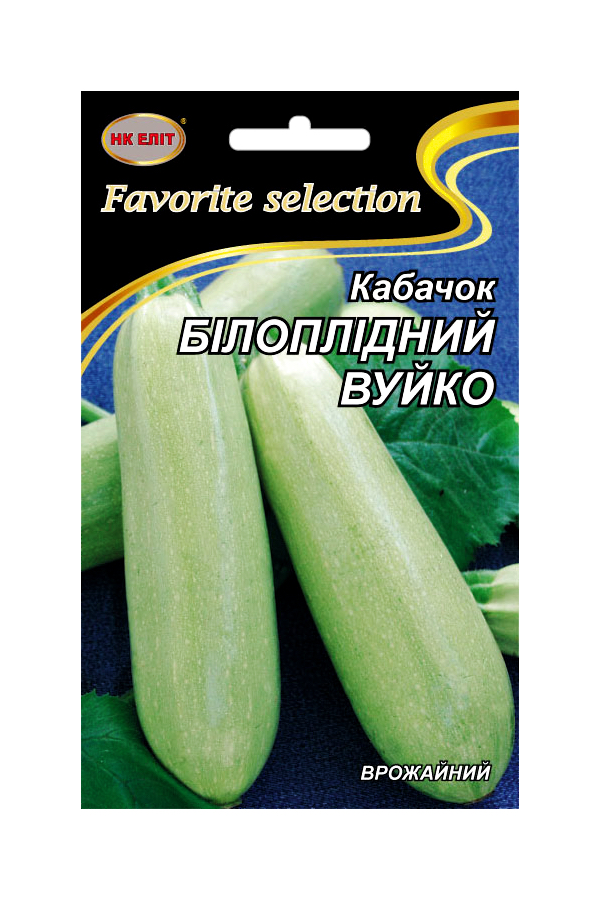
White-Fleshed Vuyko Zucchini (Favorite Selection)
White-Fleshed Vuyko is a classic high-yielding zucchini variety from NK Elit in the Favorite Selection series. Early-maturing, bush-type, compact. It produces cylindrical light-green fruits weighing 0.8–1.2 kg with tender, cream-colored flesh. Excellent for frying, stewing, canning, and freezing. Easy to care for and resistant to adverse conditions.
Characteristics
| Manufacturer: | NK Elite |
| Series: | Favorite Selection |
| Country of origin: | Ukraine |
| Type: | Variety, bush |
| Maturation period: | Early maturing, 45–50 days from germination |
| Fruit length: | 18-25 cm |
| Fruit weight: | 0.8–1.2 kg (can be harvested young at 300–400 g) |
| Fruit color: | Light green, almost white, creamy flesh |
| Yield: | 6–8 kg per bush, up to 30–40 kg/m² |
| Usage: | Versatile (fresh consumption, frying, stewing, canning, freezing) |
| Growing location: | Open field, greenhouses |
Advantages of the White-Fruited Vuyko variety
- High-yielding — a single plant will provide zucchini for the whole family all summer long
- Early-maturing — first fruits appear 45–50 days after sprouting
- Compact bush — doesn’t spread across the garden, saves space
- Long fruiting season — from June until the first frost
- Tender, stringless flesh — perfect taste even in large fruits
- Undemanding — grows in any soil, tolerates heat and lack of watering
- Cold-hardy — bears fruit until the first frost
- Versatile use — from frying to caviar and canning
- Long shelf life — keeps for up to 2–3 months in a cool place
Growing characteristics
| Stage | Recommendations |
|---|---|
| Sowing for seedlings | Late April – early May. Sow in individual cups 8–10 cm apart at a depth of 3–4 cm. Soak the seeds for 12–24 hours beforehand. Germination temperature: +25...+28°C |
| Transplanting seedlings | At 25–30 days old (3–4 true leaves), once the risk of frost has passed and the soil has warmed to +12...+15°C. Planting pattern: 70×70 cm or 80×60 cm (2–3 plants per m²) |
| Direct seeding into the soil | Second half of May, when the soil warms up to +15°C and the threat of a cold snap has passed. Sow 2–3 seeds per hole at a depth of 4–5 cm. After seedlings emerge, leave the strongest plant |
| Soil | Fertile, light, well-drained soil with a neutral pH (6-7). Apply 5-8 kg/m² of compost or humus beforehand. Good preceding crops: cabbage, onions, potatoes, beans. Do not plant after cucurbits |
| Watering | Regular, at the base of the plant, with warm water. Before flowering — once a week, 5 L per bush. During fruiting — 2–3 times a week, 8–10 liters. Avoid getting water on the leaves |
| Fertilization | 1) 10–14 days after planting — mullein infusion (1:10) or a complex nitrogen fertilizer. 2) At the start of flowering — potassium-phosphorus fertilizers. 3) During fruiting, every 10–14 days — complex fertilizers or an ash solution (1 cup per 10 L of water) |
| Care | Loosen the soil regularly and remove weeds. You can hill up the bush to encourage additional root growth. Mulch with straw or cut grass to retain moisture. Remove old yellow leaves |
| Harvesting | Regularly, every 3–5 days at the stage of technical ripeness (18–25 cm, 800 g–1.2 kg). For canning, you can harvest them young (10–15 cm, 300–400 g). Cut with a knife, leaving a 5–6 cm stem. Frequent harvesting stimulates the formation of new fruit buds |
Culinary Uses
- Fried zucchini: slice into rounds, fry in breading — a classic of summer cuisine
- Braised with vegetables: the perfect base for a stew, pairs well with tomatoes, peppers, and eggplant
- Zucchini caviar: the most popular way to preserve them for winter
- Zucchini fritters: add an egg, flour, and herbs—and a hearty dish is ready
- Baking: stuff with meat, rice, or vegetables and bake in the oven
- Canning: marinate in slices or cubes as a standalone appetizer
- Freezing: cut into cubes, blanch, and freeze for winter meals
Health benefits of zucchini
- Low in calories: only 24 kcal per 100 g — an ideal food for a healthy diet
- High in fiber: improves digestion, cleanses the intestines
- Potassium: supports heart function, removes excess fluid
- Vitamins B, C, and carotene: strengthen the immune system, improve skin condition
- Easily digestible: suitable for baby food and people with digestive issues
Disease and pest prevention
- Powdery mildew: at the first signs, treat with a baking soda solution (50 g per 10 L) or biofungicides
- White rot (Sclerotinia): remove affected fruits, do not overwater plants, ensure ventilation
- Aphids: spray with soapy water or garlic infusion
- Spider mites: increase humidity, treat with acaricides or biological agents
- Slugs: set out traps, sprinkle ash or crushed eggshells around the bushes
💡 The secret to a bountiful harvest: Zucchini are the giants of the garden—they need plenty of food! Fertilize generously with organic matter before planting, feed them during fruiting, and then a single plant will yield 20–30 zucchini per season. Also, don’t let the fruits get too big. Young zucchini measuring 15–20 cm are the tastiest, and regular harvesting encourages the plant to bear fruit even more actively. Harvest them, and in just a week, new ones will be ready! 🥒
-
Seeds
 Seeds
Buy seeds with a harvest guarantee at the "Sad-Ogorod" online store
Want to buy seeds with high germination rates at an affordable price? The "Sad-Ogorod" online store offers a wide selection of vegetable, herb, and melon seeds. Here you’ll find seeds for tomatoes, cucumbers, peppers, cabbage, carrots, beets, dill, parsley, lettuce, zucchini, eggplant, watermelon, melon, and other popular crops.
✅ Why is it beneficial to buy seeds from us?
✔ High-quality seeds from leading producers — consistent germination and high yields.
✔ A wide selection of proven varieties and hybrids for greenhouses and open fields.
✔ The ability to purchase seeds retail at wholesale prices.
✔ Fast delivery throughout Ukraine: Kharkiv, Kyiv, Dnipro, Odesa, Lviv, and other cities.
✔ Affordable prices, positive customer reviews, and professional advice.
We offer only proven seeds that have stood the test of time and are suitable for farmers, gardeners, and summer residents alike. Order seeds from the “Sad-Gorod” online store today and enjoy a bountiful, high-quality harvest!
📌 Go to the catalog and select seeds:
Seeds
Buy seeds with a harvest guarantee at the "Sad-Ogorod" online store
Want to buy seeds with high germination rates at an affordable price? The "Sad-Ogorod" online store offers a wide selection of vegetable, herb, and melon seeds. Here you’ll find seeds for tomatoes, cucumbers, peppers, cabbage, carrots, beets, dill, parsley, lettuce, zucchini, eggplant, watermelon, melon, and other popular crops.
✅ Why is it beneficial to buy seeds from us?
✔ High-quality seeds from leading producers — consistent germination and high yields.
✔ A wide selection of proven varieties and hybrids for greenhouses and open fields.
✔ The ability to purchase seeds retail at wholesale prices.
✔ Fast delivery throughout Ukraine: Kharkiv, Kyiv, Dnipro, Odesa, Lviv, and other cities.
✔ Affordable prices, positive customer reviews, and professional advice.
We offer only proven seeds that have stood the test of time and are suitable for farmers, gardeners, and summer residents alike. Order seeds from the “Sad-Gorod” online store today and enjoy a bountiful, high-quality harvest!
📌 Go to the catalog and select seeds:
- Mushroom mycelium
- Agricultural nonwoven fabric (spunbond)
-
Nets
Nets
In this section, you can select and purchase various types of nets for a wide range of applications. Vegetable nets and polypropylene bags—for packaging, storing, and transporting various agricultural products—are practical and easy to use, moisture-proof, frost-resistant, cost-effective, and environmentally friendly for use with food products. Grape cluster protection nets—allow you to keep ripening grapes on the vine for a longer period, reliably protect grapes from insect pests, wasps, and birds, while preventing the berries from rotting or being damaged by hail. Cucumber netting (trellis netting) is used to support climbing plants, guide their growth, and grow vegetables vertically in open fields, achieving cost savings through more efficient use of planting areas—yields can be doubled per square meter. Shade nets—help protect vegetable and fruit crops on land plots from the scorching sun, retain moisture in the soil, allowing plants to be watered less frequently than usual, and serve as protection for plantings by shielding them from hail, rain, wind, pests, and other external factors.
-
Everything for irrigation
 Everything for irrigation
Tools and materials used for watering plants. This section of the catalog of products for your garden and vegetable garden features high-quality universal trigger sprayers—nozzles for "Rosinka"-type PET bottles, as well as pump-type sprayers. Indispensable tools for spraying any liquids (water, fertilizer solutions, pesticides, and other aggressive substances in liquid form). Convenient and simple, they are widely used both in the home and in gardening. Watering hoses—these devices are, in most cases, simply indispensable for keeping your garden or vegetable patch in good condition. You can achieve good results with watering hoses at a very low cost: a meter of the highest-quality hose is available at a very affordable price in our agricultural store. Drip irrigation is the most effective and preferred method of watering, providing a slow and even release of water with automatic regulation. This is an advanced method of watering crops, in which water is supplied in small doses through densely branched pipes and reaches the plant roots directly via special drippers. Such watering throughout the entire growing season allows you to maintain soil moisture close to the optimal level.
Everything for irrigation
Tools and materials used for watering plants. This section of the catalog of products for your garden and vegetable garden features high-quality universal trigger sprayers—nozzles for "Rosinka"-type PET bottles, as well as pump-type sprayers. Indispensable tools for spraying any liquids (water, fertilizer solutions, pesticides, and other aggressive substances in liquid form). Convenient and simple, they are widely used both in the home and in gardening. Watering hoses—these devices are, in most cases, simply indispensable for keeping your garden or vegetable patch in good condition. You can achieve good results with watering hoses at a very low cost: a meter of the highest-quality hose is available at a very affordable price in our agricultural store. Drip irrigation is the most effective and preferred method of watering, providing a slow and even release of water with automatic regulation. This is an advanced method of watering crops, in which water is supplied in small doses through densely branched pipes and reaches the plant roots directly via special drippers. Such watering throughout the entire growing season allows you to maintain soil moisture close to the optimal level.
-
Everything for seedlings
Everything for seedlings
This section features effective tools for plant seedlings: greenhouses and seedling trays, pots, peat and coconut pellets. Seedling trays and greenhouses are a cost-effective and convenient way to grow your future harvest; they include a tray to retain moisture and a seedling tray. Seedling pots, available in various diameters and sizes, are used in gardening and floriculture and are designed for growing any plants, vegetable seedlings, and various ornamental plants. They are intended for both professionals and hobbyists. Peat pellets are an effective and simplified way to grow seedlings of vegetable and flower crops. By using this product for seedlings, you will find it convenient to use and achieve better results when growing any crops than with the conventional seedling method.
- Insecticides
- Herbicides
- Fungicides
- Plant growth stimulants
- Plant Bioprotection
- Seed treatments
- Polyethylene film
- Adhesives
- Universal plant protection products
-
Fertilizers
- "Master" Fertilizers
- "Clean Leaf" Crystal Fertilizer 900 g
- "Plantator" Fertilizers
- "Baikal" Fertilizers
- "Helatin" Fertilizers
- "Magic Mix" Fertilizers
- "Kemira Lux" Fertilizers
- Mineral fertilizers
- Humate-based fertilizers
- "Quantum" Fertilizers
- "Stimul" Fertilizers
- "Clean Leaf" Plant Care Products
- "Clean Leaf" Crystal Fertilizers 20 g
- "Avangard" Fertilizers
- "Sudarushka" and "Ryazanochka" fertilizers
- "Chisty List" crystalline fertilizers, 100 g
- "Clean Leaf" Crystal Fertilizer 300 g
- "Clean Leaf" Fertilizer in Sticks
Fertilizers
Fertilizers for your garden and vegetable garden. This product category offers our customers the best and most in-demand high-quality fertilizers for growing a wide variety of agricultural crops and plants. These are concentrated water-soluble fertilizers—granulated and universal—containing mineral, nitrogen, phosphorus, urea, sodium, calcium, and ammonium (nitrate) additives and compounds. We offer a range of fertilizers from Agrolux, Reacom, Master, and Plantafol, as well as nitrogen fertilizers such as urea and ammonium nitrate. Baikal EM1 is a concentrated, universal liquid formulation containing a large number of beneficial microorganisms that naturally inhabit the soil. The following products are in high demand and available for purchase: boric acid, potassium humate and potassium fertilizer, Ryazanochka, Sudarushka, magnesium sulfate, zinc sulfate, potassium nitrate, and the phosphorus fertilizer Superphosphate, as well as many others.
- "Master" Fertilizers
- Sprayers
- Flower pots, planters
- Gloves
- Tents
- Measures to protect against the Colorado potato beetle
- Pest control products for cockroaches, German cockroaches, bed bugs, fleas, and house and garden ants
- Protection against mosquitoes, gnats, ticks, wasps, midges, and horseflies
- Fly repellents
- Moth repellents
- Measures to protect against cabbage root maggots
- Mole control products
- Rodent Control Products
- Products for septic tanks, cesspools, and outhouses, biodegradable agents
- Household goods
- Plant protection products
- Best Sellers
- Buy seeds - bestsellers
-
Archive
- Assortment 1
- Assortment 2
- Assorted 3
- Substrates
- "Agrolyuks" Fertilizers
- Candles
- Pickling bags
- Fertilizer Application
- Seeds Professional Packaging Netherlands
- Cucumber seeds in professional packaging

- Tomato seeds in professional packaging
- Watermelon seeds in professional packaging
- Eggplant seeds in professional packaging
- Zucchini seeds in professional packaging
- Cabbage seeds in professional packaging
- Pepper seeds in professional packaging
- Carrot seeds in professional packaging
- Beet seeds in professional packaging
- Radish seeds in professional packaging
- Cucumber seeds in professional packaging
Archive
Archive of products that are currently out of stock, but if they become available, we will easily move them to the appropriate sections. If you have landed on this page and see that a product is out of stock, you may be interested in other similar or related products—please use the search function on our website or browse other sections.
- Assortment 1


