

Working hours: Mon–Sat, 9:00 to 18:00. Orders accepted online: 24/7
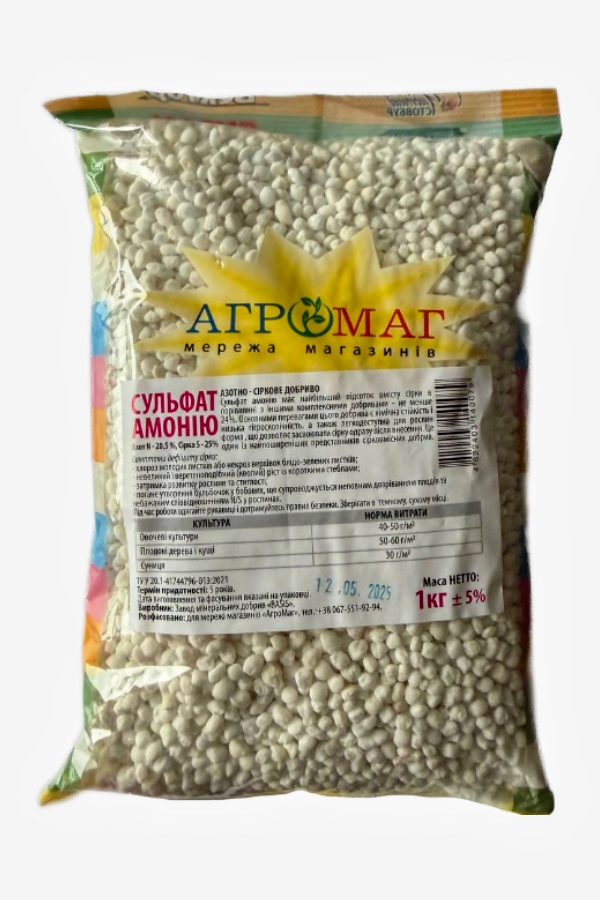
Ammonium Sulfate 1 kg
UAH 59.00
Ammonium Sulfate 1 kg
Quantity
Full description
Ammonium sulfate 1 kg
Ammonium sulfate (NH₄)₂SO₄ is a classic nitrogen-sulfur fertilizer that works on all soil types. It contains 21% nitrogen in the ammonium form and 24% sulfur. It is particularly effective on alkaline soils, where it acidifies the environment and improves nutrient uptake. An ideal choice for sulfur-loving crops: cabbage, onions, garlic, and legumes.
Specifications
| Brand: | Agromag |
| Country of origin: | Ukraine |
| Ass: | 1 kg |
| Product type: | Mineral nitrogen-sulfur fertilizer |
| Form: | Granules |
| Composition: | N (nitrogen) - 21%, S (sulfur) - 24% |
| Crops: | Vegetables, fruit and berry crops, ornamental plants, lawn grasses |
Advantages
- Dual action: supplies plants with nitrogen and sulfur simultaneously
- The ammonium form of nitrogen does not leach from the soil and lasts longer
- Acidifies alkaline soils, improving the uptake of phosphorus and micronutrients
- Sulfur improves protein quality, taste, and aroma of fruits
- Dissolves well in water — suitable for root and foliar feeding
- Works even at low temperatures
- Cost-effective compared to other nitrogen fertilizers
What nitrogen and sulfur provide to plants:
- Nitrogen: a building block for proteins, chlorophyll, and enzymes. Stimulates the growth of leaves and shoots, increases yield.
- Sulfur: essential for the synthesis of amino acids, vitamins, and essential oils. Improves the taste, aroma, and shelf life of fruits.
- In summary: nitrogen without sulfur is absorbed less efficiently, so ammonium sulfate is the optimal combination for balanced nutrition.
Application guidelines:
| Crop | Application rate | Application method | Application period |
|---|---|---|---|
| Cabbage, onion, garlic | 30–40 g/m² | Apply during plowing or broadcast followed by incorporation | In the spring before planting or as a top-dressing 2–3 weeks after planting |
| Tomatoes, peppers, eggplants | 20-30 g/m² | Apply before planting or as a solution for watering: 20-30 g per 10 L of water | First fertilization 10–14 days after transplanting seedlings |
| Cucumbers, zucchini | 15–20 g/m² | Watering solution: 15 g / 10 L of water | Fertilize during the active growth period, 2–3 times per season |
| Potatoes | 25-30 g/m² | Apply to planting holes or spread before planting | In the spring during soil preparation |
| Strawberries, wild strawberries | 15-20 g/m² | Scatter between rows followed by watering, or a solution of 15 g / 10 L | Early spring after leaf emergence or after fruiting |
| Fruit trees | 30–50 g per 1 m² of the tree circle | Spread around the trunk, then cover and water | Early spring before the growing season begins |
| Lawn grass | 20–30 g/m² | Evenly spread over the surface, followed by watering | In spring and summer to maintain a rich green color |
| Flowers and ornamental plants | 15–25 g/m² | Application before planting or as a solution for watering | Spring and early summer to stimulate growth |
Important recommendations:
- Don’t overdo it: excess nitrogen leads to plant legging, delayed flowering, and reduced disease resistance
- Spread evenly: when applying in dry form, the fertilizer should be spread evenly and worked into the soil to a depth of 5–10 cm
- Water after application: to dissolve the granules and ensure rapid uptake
- Do not use in late fall: nitrogen stimulates growth, which can reduce the winter hardiness of perennial crops
- Compatibility: mixes well with phosphorus and potassium fertilizers
For which crops is ammonium sulfate the best choice:
- Cabbage family: all types of cabbage, radish, radish, mustard — they thrive on sulfur to develop their characteristic flavor
- Alliaceae: onions, garlic, leeks — sulfur enhances phytoncidal properties and pungency
- Legumes: peas, beans, soybeans — improves nitrogen fixation from the air
- Cruciferous: rapeseed, mustard — sulfur is a component of glucosinolates
- Crops on alkaline soils: the acidifying effect improves the uptake of phosphorus and micronutrients
💡 Tip: It is better to apply ammonium sulfate in the spring rather than in the fall. Unlike nitrate, it doesn’t act as quickly, but it nourishes plants for a longer period. It’s ideal for soils with a pH above 7, where it acidifies the environment and makes nutrients more available.
-
Seeds
 Seeds
Buy seeds with a harvest guarantee at the "Sad-Ogorod" online store
Want to buy seeds with high germination rates at an affordable price? The "Sad-Ogorod" online store offers a wide selection of vegetable, herb, and melon seeds. Here you’ll find seeds for tomatoes, cucumbers, peppers, cabbage, carrots, beets, dill, parsley, lettuce, zucchini, eggplant, watermelon, melon, and other popular crops.
✅ Why is it beneficial to buy seeds from us?
✔ High-quality seeds from leading producers — consistent germination and high yields.
✔ A wide selection of proven varieties and hybrids for greenhouses and open fields.
✔ The ability to purchase seeds retail at wholesale prices.
✔ Fast delivery throughout Ukraine: Kharkiv, Kyiv, Dnipro, Odesa, Lviv, and other cities.
✔ Affordable prices, positive customer reviews, and professional advice.
We offer only proven seeds that have stood the test of time and are suitable for farmers, gardeners, and summer residents alike. Order seeds from the “Sad-Gorod” online store today and enjoy a bountiful, high-quality harvest!
📌 Go to the catalog and select seeds:
Seeds
Buy seeds with a harvest guarantee at the "Sad-Ogorod" online store
Want to buy seeds with high germination rates at an affordable price? The "Sad-Ogorod" online store offers a wide selection of vegetable, herb, and melon seeds. Here you’ll find seeds for tomatoes, cucumbers, peppers, cabbage, carrots, beets, dill, parsley, lettuce, zucchini, eggplant, watermelon, melon, and other popular crops.
✅ Why is it beneficial to buy seeds from us?
✔ High-quality seeds from leading producers — consistent germination and high yields.
✔ A wide selection of proven varieties and hybrids for greenhouses and open fields.
✔ The ability to purchase seeds retail at wholesale prices.
✔ Fast delivery throughout Ukraine: Kharkiv, Kyiv, Dnipro, Odesa, Lviv, and other cities.
✔ Affordable prices, positive customer reviews, and professional advice.
We offer only proven seeds that have stood the test of time and are suitable for farmers, gardeners, and summer residents alike. Order seeds from the “Sad-Gorod” online store today and enjoy a bountiful, high-quality harvest!
📌 Go to the catalog and select seeds:
- Mushroom mycelium
- Agricultural nonwoven fabric (spunbond)
-
Nets
Nets
In this section, you can select and purchase various types of nets for a wide range of applications. Vegetable nets and polypropylene bags—for packaging, storing, and transporting various agricultural products—are practical and easy to use, moisture-proof, frost-resistant, cost-effective, and environmentally friendly for use with food products. Grape cluster protection nets—allow you to keep ripening grapes on the vine for a longer period, reliably protect grapes from insect pests, wasps, and birds, while preventing the berries from rotting or being damaged by hail. Cucumber netting (trellis netting) is used to support climbing plants, guide their growth, and grow vegetables vertically in open fields, achieving cost savings through more efficient use of planting areas—yields can be doubled per square meter. Shade nets—help protect vegetable and fruit crops on land plots from the scorching sun, retain moisture in the soil, allowing plants to be watered less frequently than usual, and serve as protection for plantings by shielding them from hail, rain, wind, pests, and other external factors.
-
Everything for irrigation
 Everything for irrigation
Tools and materials used for watering plants. This section of the catalog of products for your garden and vegetable garden features high-quality universal trigger sprayers—nozzles for "Rosinka"-type PET bottles, as well as pump-type sprayers. Indispensable tools for spraying any liquids (water, fertilizer solutions, pesticides, and other aggressive substances in liquid form). Convenient and simple, they are widely used both in the home and in gardening. Watering hoses—these devices are, in most cases, simply indispensable for keeping your garden or vegetable patch in good condition. You can achieve good results with watering hoses at a very low cost: a meter of the highest-quality hose is available at a very affordable price in our agricultural store. Drip irrigation is the most effective and preferred method of watering, providing a slow and even release of water with automatic regulation. This is an advanced method of watering crops, in which water is supplied in small doses through densely branched pipes and reaches the plant roots directly via special drippers. Such watering throughout the entire growing season allows you to maintain soil moisture close to the optimal level.
Everything for irrigation
Tools and materials used for watering plants. This section of the catalog of products for your garden and vegetable garden features high-quality universal trigger sprayers—nozzles for "Rosinka"-type PET bottles, as well as pump-type sprayers. Indispensable tools for spraying any liquids (water, fertilizer solutions, pesticides, and other aggressive substances in liquid form). Convenient and simple, they are widely used both in the home and in gardening. Watering hoses—these devices are, in most cases, simply indispensable for keeping your garden or vegetable patch in good condition. You can achieve good results with watering hoses at a very low cost: a meter of the highest-quality hose is available at a very affordable price in our agricultural store. Drip irrigation is the most effective and preferred method of watering, providing a slow and even release of water with automatic regulation. This is an advanced method of watering crops, in which water is supplied in small doses through densely branched pipes and reaches the plant roots directly via special drippers. Such watering throughout the entire growing season allows you to maintain soil moisture close to the optimal level.
-
Everything for seedlings
Everything for seedlings
This section features effective tools for plant seedlings: greenhouses and seedling trays, pots, peat and coconut pellets. Seedling trays and greenhouses are a cost-effective and convenient way to grow your future harvest; they include a tray to retain moisture and a seedling tray. Seedling pots, available in various diameters and sizes, are used in gardening and floriculture and are designed for growing any plants, vegetable seedlings, and various ornamental plants. They are intended for both professionals and hobbyists. Peat pellets are an effective and simplified way to grow seedlings of vegetable and flower crops. By using this product for seedlings, you will find it convenient to use and achieve better results when growing any crops than with the conventional seedling method.
- Insecticides
- Herbicides
- Fungicides
- Plant growth stimulants
- Plant Bioprotection
- Seed treatments
- Polyethylene film
- Adhesives
- Universal plant protection products
-
Fertilizers
- "Master" Fertilizers
- "Clean Leaf" Crystal Fertilizer 900 g
- "Plantator" Fertilizers
- "Baikal" Fertilizers
- "Helatin" Fertilizers
- "Magic Mix" Fertilizers
- "Kemira Lux" Fertilizers
- Mineral fertilizers
- Humate-based fertilizers
- "Quantum" Fertilizers
- "Stimul" Fertilizers
- "Clean Leaf" Plant Care Products
- "Clean Leaf" Crystal Fertilizers 20 g
- "Avangard" Fertilizers
- "Sudarushka" and "Ryazanochka" fertilizers
- "Chisty List" crystalline fertilizers, 100 g
- "Clean Leaf" Crystal Fertilizer 300 g
- "Clean Leaf" Fertilizer in Sticks
Fertilizers
Fertilizers for your garden and vegetable garden. This product category offers our customers the best and most in-demand high-quality fertilizers for growing a wide variety of agricultural crops and plants. These are concentrated water-soluble fertilizers—granulated and universal—containing mineral, nitrogen, phosphorus, urea, sodium, calcium, and ammonium (nitrate) additives and compounds. We offer a range of fertilizers from Agrolux, Reacom, Master, and Plantafol, as well as nitrogen fertilizers such as urea and ammonium nitrate. Baikal EM1 is a concentrated, universal liquid formulation containing a large number of beneficial microorganisms that naturally inhabit the soil. The following products are in high demand and available for purchase: boric acid, potassium humate and potassium fertilizer, Ryazanochka, Sudarushka, magnesium sulfate, zinc sulfate, potassium nitrate, and the phosphorus fertilizer Superphosphate, as well as many others.
- "Master" Fertilizers
- Sprayers
- Flower pots, planters
- Gloves
- Tents
- Measures to protect against the Colorado potato beetle
- Pest control products for cockroaches, German cockroaches, bed bugs, fleas, and house and garden ants
- Protection against mosquitoes, gnats, ticks, wasps, midges, and horseflies
- Fly repellents
- Moth repellents
- Measures to protect against cabbage root maggots
- Mole control products
- Rodent Control Products
- Products for septic tanks, cesspools, and outhouses, biodegradable agents
- Household goods
- Plant protection products
- Best Sellers
- Buy seeds - bestsellers
-
Archive
- Assortment 1
- Assortment 2
- Assorted 3
- Substrates
- "Agrolyuks" Fertilizers
- Candles
- Pickling bags
- Fertilizer Application
- Seeds Professional Packaging Netherlands
- Cucumber seeds in professional packaging

- Tomato seeds in professional packaging
- Watermelon seeds in professional packaging
- Eggplant seeds in professional packaging
- Zucchini seeds in professional packaging
- Cabbage seeds in professional packaging
- Pepper seeds in professional packaging
- Carrot seeds in professional packaging
- Beet seeds in professional packaging
- Radish seeds in professional packaging
- Cucumber seeds in professional packaging
Archive
Archive of products that are currently out of stock, but if they become available, we will easily move them to the appropriate sections. If you have landed on this page and see that a product is out of stock, you may be interested in other similar or related products—please use the search function on our website or browse other sections.
- Assortment 1


